Hey! Pay attention!
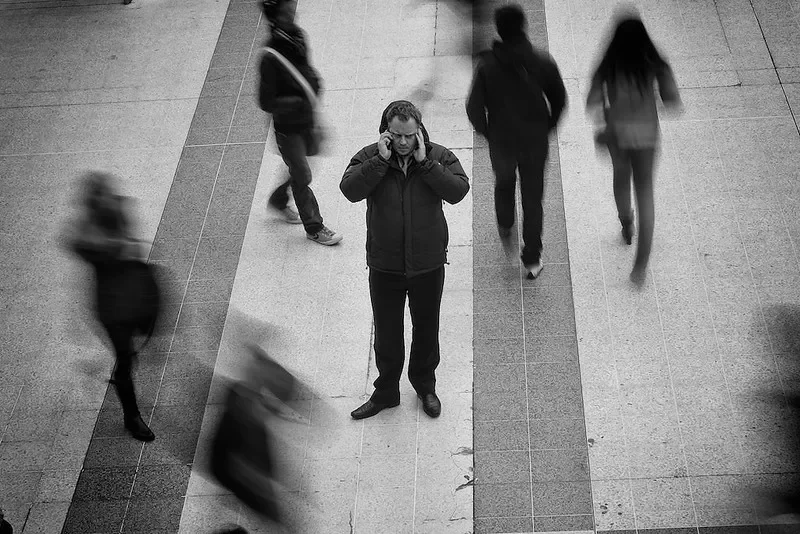
Tuning in: not necessarily straightforward. Photo by Martin.Mutch at Flickr.com
Are you even listening?
If being asked to ‘pay attention!’ reminds you of your least inspiring secondary school teacher, you’re not alone. It’s not a phrase that tends to fill us with delight.
And yet. When we do pay attention, when give our time gladly, we often find that other people reach their point quicker, that they think more clearly and succinctly. They might even solve their problem for themselves.
We have some strange ideas about attention
The closer you look at it, the more you realise that we have some pretty weird ideas about what ‘paying attention’ means. And that’s partly to do with language.
Alongside the implicit tediousness, there’s also a peculiar suggestion of a financial transaction.
To ‘pay attention’ actually belongs to a whole family of metaphors, the chief of which is:
Time is money.
It’s a concept so pervasive in the English language that it shapes our thinking without us particularly noticing. We understand one idea through another, quite different, concept. And having done so, a whole other set of related ideas start to flow on from this.
So for example, it follows that if time is money, then it must also be true that time is a limited resource:
“time’s up!”
“there isn’t enough time”,
“time is running out for us, darling…”
…and likewise, that time is a valuable resource:
“spend your time wisely”,
“don’t waste time”,
“sorry for the cold approach on LinkedIn… I promise it’ll be worth your time!”
And this is why we ‘pay’ attention, which might otherwise seem like a strange choice of word. And isn’t that a drag?
And yet. When we do pay attention, when we relax and offer someone our time and do not hurry them, we very often find that reach their point quicker, that they think more clearly and succinctly, and even solve the problem themselves.
Attention is fundamental to coaching
Paying attention is a core coaching skill. To offer up attention of the special quality that helps someone else to unfold and develop their thinking before you. It takes practice (boy, does it take practice!) but it is a beautiful thing to see. Not only that, the results are predictable and repeatable.
So, why is it so difficult to do?
Why it’s hard to pay attention
Well, the metaphor has got a few things spot on. Firstly, attention really is a limited resource.
Your working memory is limited. We used to talk about ‘seven items or fewer’ as being an optimum or maximal number for both the fast checkout aisle and the mind. More recent research is clear that there isn’t, in fact, a particular number of ‘slots’ in your brain, and certainly nothing that we could think of as being universal to all. But it is true that we all start to creak when we try to hold too many things in mind at the same time.
We also know that irrelevant information is a distraction, and so is resisting a temptation. (Fun studies include sticking cakes rather than fruit in the room while people try to do maths problems. Maybe one to remember for your next board meeting). Suppressing emotion (or alternatively, being expected to amp it up) also saps stamina.
So yes, your attention really is a limited resource.
It’s also an increasingly competed one.
The competed mind
I read a disturbing piece in an academic marketing journal that noted the cognitive cost (there we go again - it has a price) that comes with task-switching, especially when you’re dual-screening. (That is, watching TV on the sofa and scrolling Instagram on your phone, or being pinged by the Saturday five-a-side league while trying to get the report finished). Instead of looking at how to reduce those costs (as someone who was actually interested in your wellbeing might) or even to capture your attention more fully (as a more creative advertiser might), the authors were in search of ways to work with what they called ‘variable attention states’ so that their message got through even if we were only half-listening, or amusing ourselves in the ad break. In other words: trying to design a sort of background drone you simply cannot shake.
As for social media itself… well, as the user, we don’t pay a subscription to Instagram or X (or at least, we maybe don’t mention it at parties if we do). Instead, your attention is the product. And this is what advertisers are buying.
You may find social media either useful, enjoyable or both. Perhaps you use it to keep up to date with family overseas, for trading cycling gear, or pursuing a niche interest in rehoming rescued hedgehogs. Or maybe you're someone whose tech-neck is causing you daily pain, and can’t see a view without picturing a square frame around it. Perhaps you have chosen digital monasticism.
But whatever your relationship with social media, you know this to be true: more people than ever before want a slice of your attention. Sometimes its worth your time. A lot of it isn’t.
Our attention is under siege. And so we hesitate to give it wholly to anything.
The jealousy with which we withhold our attention directly reflects how out of control we feel; how unable to guard and protect the focus we have.
The cost of inattention
Yet when we do give the gift of our attention, it’s radical (increasingly so), and transformative. As a coach I wonder whether the world at large is crying out for the full attention of someone around us.
Consider, for example:
The amount of time wasted because someone didn’t feel fully heard by us (screaming into the void, anyone…?)
The colleague whose concerns weren’t adequately heeded. The quirk of the data that we overlooked, or dismissed as an anomaly or coincidence, that turned out not to be.
The superficial quality of our relationships when we spread ourselves so thinly that we can’t give anyone the attention they deserve. The energy consumed by the resulting resentment and confusion.
The management span that we know, really, is too wide for us to give any of our reports the attention they need to develop and grow, leaving us permanently overstretched.
A new take on attention
Here’s the thing. Time isn’t actually money. That’s a largely outdated notion that equates labour in with pay out.
Time might possibly be … an opportunity. A gift. A glittering moment, or a sentence without parole.
Great attention isn’t measured in time spent, but in quality. And nor is it really a transaction. (Who here feels like someone is really giving them their attention if that person is - figuratively - drumming their fingers and waiting for us to make it worth their while?). Great attention is a gift without expectation of return that nourishes both the giver and receiver.
What’s more, as a coach I can tell you that giving great attention also feels, well, great. It has an almost meditative aspect - like entering into a flow state.
…so how do you do that exactly?!
Eliminating clutter
We start, as I hope you always do, by silencing notifications, setting your ‘do not disturb.’ (And if you think someone checking their wristwatch while you’re talking is rude, I raise you one Apple Watch. Every involuntary glance at your step counts, WhatsApp messages, and emails let the people you with know just how much of your attention you’re prepared to give them. It’s not pretty.)
Also consider removing physical clutter, such as excessive signage in your workplace, lettering and text of all kinds. Marie Kondo, who has given up on a perfectly tidy home having had 3 children (what sweet relief), nonetheless recommends removing labels and packaging from everyday objects to quiet the “visual noise”. No one needs a morning lecture from the cornflakes box.
If you can, create vistas to the natural world, or at the very least, put up a selfie from your last hike or beach trip. Cultivate spaciousness.
Consider company-wide comms carefully, especially regarding rules, procedures, manuals of all kinds. Does a policy document really need to be read by all today, or is it a how-to guide to consult (or even better, built into a workflow) when you need it? Consider what might be the most important messages to get through.
Consolidate
Less frequent, but deeper, discussions may be a better use of your diary, reduce task-switching costs, and get better and more meaningful results.
The most profound impact may be felt in your one-to-ones, and a review of management spans may be necessary to achieve this. Not too many layers, and not too wide. Elaborate hierarchies in small teams introduce complexity (it’s always possible to recognise expertise without assigning management responsibilities), and being spread too thinly makes busy fools of under-leveraged managers.
Set aside some ‘deep work’ time, without distractions and interruptions - whether that’s a meeting or a ‘ding!’ from your devices. Do not, under any circumstances, use it for admin, which expands to fill any available void.
Offer yourself some high quality attention
Often our reluctance to give to others is due to a lack we feel ourselves.
Cultivate body-awareness (often an easier place to start than the mind) by doing a thorough stretching routine, paying close attention to the feelings in your body. Book a massage. For the mind, spend some time in meditation. Take a walk by yourself in nature near something green.
Now you’re feeling brave: sit or stand at the station or the coffee shop, or wait for a friend, without fiddling with your phone, reading the paper, or reacting to anything in particular. Practice the art of “being bored quietly” (which according to a headmistress friend, is the primary relevance of school assemblies). See what comes into your brain - without judgement, simply observation.
It may be the most important piece of data you’ve received all week.
Summary Recommendations
How to banish distraction and give attention gladly.
Recognise the extent to which your attention feels under siege, to be guarded at all costs.
Recognise that great attention is a question of quality not quantity.
Eliminate clutter, be that digital notifications, obtrusive signage, or blanket staff comms on non-critical issues. Cultivate spaciousness in your working environment.
Structure your week to include fewer, deeper conversations and some protected “deep work” time.
Review your management spans: avoid elaborate hierarchies (too deep) and an unmanageable number of reports (too wide).
Give yourself a taste of the attention you are lacking. Start with the body (stretch thoroughly, take a massage), then the mind. Meditate, spend time in reflection, bravely risk the possibility of boredom and give yourself time to think without external inputs.
Show up.